
Academics
Our Approach

Humanities
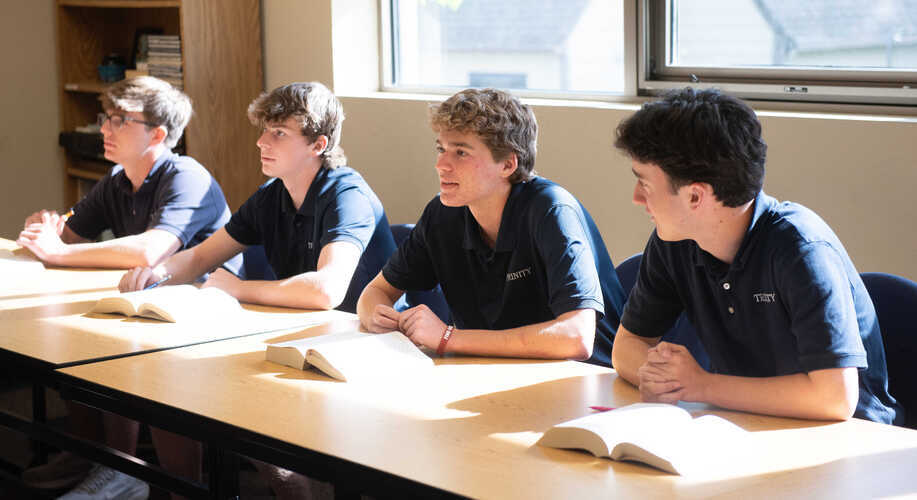
Genuine understanding takes root only when students engage deeply—wrestling with ideas, recognizing connections, and arriving at insights for themselves. By introducing students to great works of literature and history each year, and by continually inviting them to read, discuss, and write about them, we hone active-learning and analytical reasoning skills and invite students to grapple with the timeless and essential questions of what it means to be human.
Math & Science
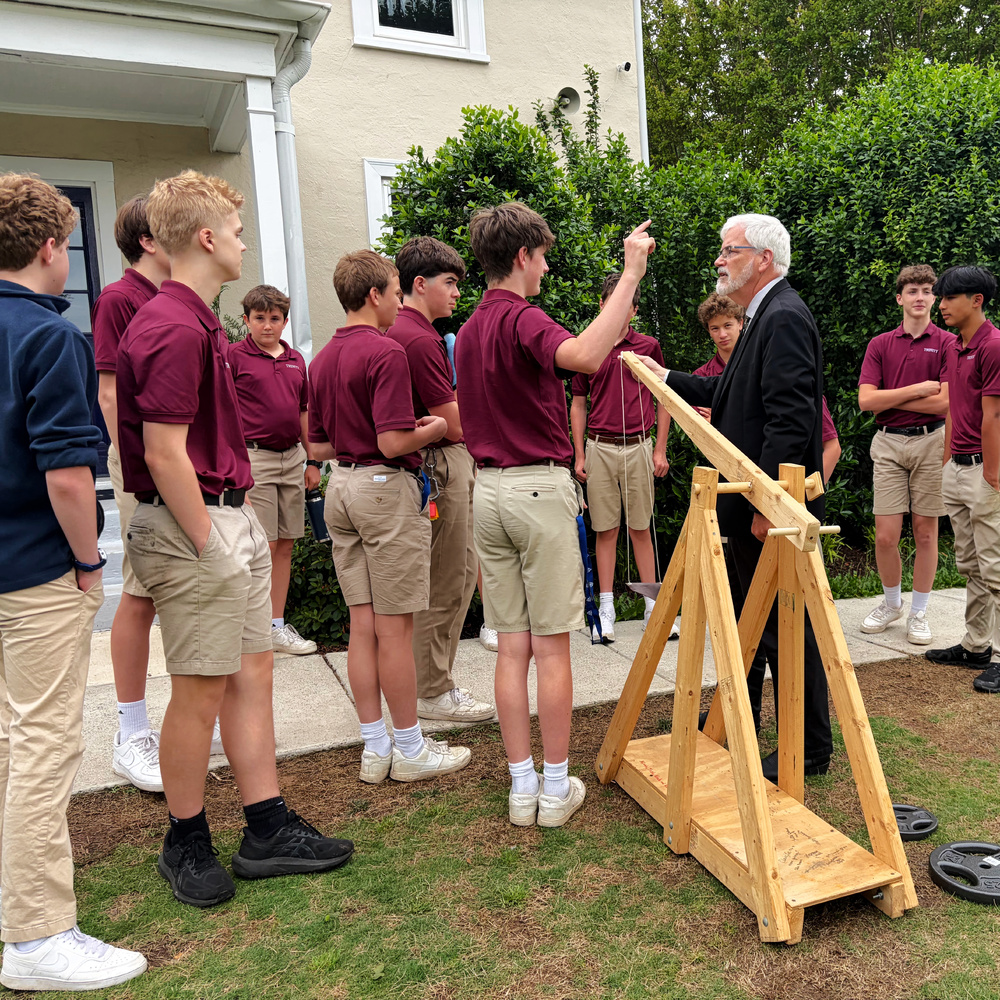
Our six-year science curriculum introduces students to the power of observation and data analysis. Along the way, the math program seeks proficiency through conceptual understanding. Taught by faculty members who appreciate the beauty of science and math as ways to encounter the created world, our naturally curious students become proficient problem solvers, careful observers, and keen investigators.

The Arts
Trinity Academy treasures beauty—both as something to behold and contemplate, and as something to create. In art classes, students train their eyes and hands by copying masterworks. In music, they learn to read scores, play recorders, compose four-part pieces, and sing in choirs. In drama, every student participates in two full-length classical productions. They learn acting skills, explore the motivations and development of their characters, design and build sets, and create props and costumes.
-1.jpg?width=592&height=500&name=Joyce%20and%20Nathan%20(1)-1.jpg)
Classical Approach
Classical education can mean different things at different schools. At Trinity Academy it is a three-pronged liberal arts and sciences approach that includes reading great works, engaging with reality through a robust math and science program, and participating in the fine arts. Our classrooms are highly participatory seminar-style spaces where conversation abounds. Students write essays on paper, grapple with challenging math problems, and create beautiful art. Not only does our program allow students to flourish intellectually, it provides them with the foundations of learning that will last a lifetime.
Course Guide by Grade
Curricular Overview
We welcome you to use this guide to introduce yourself to the Trinity Academy curriculum. Start with Grade 7 to get a sense of the whole, six-year course progression, or go directly to your child’s current or rising grade level for a curriculum overview.
Pre-Algebra
Students are prepared for the study of algebra and introduced to basic geometric concepts. They learn about numbers and their properties, especially integers, decimals, fractions and percentages. They also study linear equations and the use of variables in simple expressions, equations, and inequalities. They are introduced to elementary set theory and end the course by focusing on geometric figures and their properties. (Two semesters)
Literature and Composition
Students begin a careful study of English grammar that continues through the 7th and 8th grade years. They learn how to write a coherent sentence and start working towards organizing their thoughts into a paragraph. They also learn how to read both poetry and longer fiction works accurately and with engagement. See the reading list for the literature in the course. (Two semesters)
Ancient History
Students explore early civilizations from the rise of the Sumerians around 3500 BC to the sack of Rome in 410 AD, with an emphasis upon the Greco-Roman civilizations. The study begins with the Ancient Near East, and moves on to Egypt, Greece, and Rome. Through reading and a number of hands-on activities, students are introduced to the significant questions and tensions of civilization itself, such as how to balance security and freedom and what features of a political arrangement best promote human thriving. (Two semesters)
Latin
Students begin their study of Latin in an immersive environment. They are introduced to grammar and vocabulary through the reading of Latin stories, and by listening to and responding to Latin sentences aloud. In the first year, the 7th graders focus on Latin noun forms and the five declensions, and on the acquisition of vocabulary. (Two semesters)
Science
Students study a wide variety of topics including insects, soil, weather, and astronomy. The development of precise, careful observation and an active sense of wonder are foundational to the course. (One semester)
Old Testament
Students read many of the narrative accounts of the Old Testament. Emphasis is placed upon God’s establishment of a covenant with his people, the history of Israel, and the messianic hope through the age of the prophets. The course is designed to allow students to enter into the Scriptures on their own terms, identifying with the characters, and tracing out the story of God’s history with Israel. (One semester)
Music
Students are introduced to music theory and learn to play the alto recorder. They learn note-reading in the treble and bass clefs, note values and rhythm, and time signatures. They sing hymns and folk songs and listen to classical music, and also spend some time composing at the keyboard. By the end of the semester, students both perform in recorder ensembles and write several elementary melodies. (One semester)
Art
Students learn about line, shape, color, and texture. They begin by practicing the Uncial font in calligraphy. They design decorative/illuminated letters, looking closely at positive and negative space and how colors work. They end the semester with learning about texture in drawing. (One semester)
Course Guide Grade 8
Algebra
Students develop fluency in working with linear and quadratic equations and their graphs. They investigate and explore mathematical ideas and relationships and develop multiple strategies for analyzing complex situations. They review properties of real numbers, learn to simplify or solve algebraic expressions, equations, and inequalities, and learn to add, subtract, multiply and factor polynomials. Horizontal enrichment is available for advanced students. (Two semesters)
Literature and Composition
Students read and discuss literature, develop a mastery of English grammar and punctuation, and learn how to write a formally organized paragraph that becomes the basis for later essays. See our reading list for the literature of the course. (Two semesters)
Medieval History
Students study the history of Western Europe from 410 AD to the beginning of the Renaissance, learning about the emergence and spread of Christianity in the Roman Empire, the Germanic and Viking invasions, the development of feudalism and manorialism, the struggles between the church and secular authorities, and the conflict between Islam and Christian Europe. (Two semesters)
Latin II
Students continue their study of Latin in an immersive environment. They are introduced to new grammar and vocabulary through the reading of Latin stories and by listening to and responding to Latin sentences aloud. The 8th graders continue to master Latin noun forms in the five declensions, continue to develop their familiarity with adjectives and pronouns, and begin their study of verbs. (Two semesters)
Science
Students continue to build on observational skills and develop a sense of wonder about the natural world. Topics which are covered include: maps and topography, minerals and rocks, plate tectonics, trees, and simple machines. (One semester)
New Testament
Students review the Old Testament claims about the end of Israel’s exile and then proceed with an in-depth reading of the Gospel of Luke as the story of God acting in the person of Jesus to fulfil his promises. They then read the Acts of the Apostles and excerpts from the Epistles and the Book of Revelation. (One semester)
Music II
Students build on the musical foundations laid in seventh grade. They play in recorder ensembles, spending much of their class time rehearsing repertoire by such composers as Praetorius, Bach, Victoria, and Palestrina. They continue to develop their ability to identify intervals aurally, visually, and at the keyboard. The students compose short duets and perform them with their classmates. As in seventh grade, they also sing and spend time listening to classical music. (One semester)
Art II
Students learn how to draw looking closely at lines and shading. They create family portraits with graphite and then learn about color-mixing through using colored-pencils and watercolor. The focus is on drawing perspective and depth. (One semester)
Course Guide Grade 9
Humane Letters Seminar
Students study American history and letters from colonial times to the mid-20th century, reading original texts, with special attention given to the foundational texts of American democracy. Students begin to develop the fundamental skills necessary to participate effectively in the seminar and to write a five-paragraph essay. See our reading list for the literature of the course. (Two semesters)
Biology
Students review the scientific method and are introduced to the unique character of biological science. From there, students study elementary physical building blocks of matter, the molecules of life, basic cell structure, respiration and photosynthesis, DNA, Mendelian genetics, evolution, ecology, and animal morphology. The second semester includes dissections from the earthworm to the fetal pig. (Two semesters)
Geometry
Students study the geometry of objects, including lines, triangles and circles. They are taught to extract mathematical information from visual images of geometrical objects, to understand the mathematical relationships between geometrical objects, and the structure and role of proofs in geometry. (One semester)
Precalculus A
Students review their studies of Algebra and learn about polynomial and rational functions. Functions are represented graphically, symbolically and numerically. Horizontal enrichment is available for advanced students. (One semester)
Doctrine (Protestant or Catholic)
As a way to provide enrichment of their reading of the Old and New Testaments, students continue their study of God’s work in the world by examining the history, traditions, and beliefs of their own denominations or traditions. Students choose between Roman Catholic and Protestant Doctrine. Roman Catholic Doctrine Students learn the beliefs, practices and doctrines of the Roman Catholic Church as expressed in the Nicene Creed, the Catechism of the Catholic Church, and the sacraments.
Protestant Doctrine Students focus on reading and examining primary texts as they work sequentially through church history. After a study of the early church, they examine the Christological and Trinitarian controversies that led to the development of the creeds, key developments in the Middle Ages, the work of the Reformers in the 16th century, and the early development of the church in America. Each student then participates in an independent study of the foundations, doctrines, and practices of their own denomination or tradition. (One semester)
Latin III
Students continue to use the Familia Romana textbook in order to improve their ability to read Latin and deepen their understanding of its grammar and structure. They master enough material in the first semester to prepare them to read original Latin texts in the second. (Two semesters)
Transfer Latin
(For new 9th grade students without previous Latin study) Students read through Familia Romana at an accelerated pace, as they prepare to assimilate with their classmates in Latin III. They learn a range of vocabulary and common grammatical constructions that aid them in reading Latin with understanding. In this small class, instruction is tailored individually to the student’s needs. (Two semesters)
Music III
Students study the theory of four-part harmony and learn to compose pieces of this kind. They also sing as part of the curricular choir, in which they practice healthy vocal technique, learn how to read a choral score, and perform in an ensemble. The semester culminates with each of the students composing a four-part vocal piece as their final project and performing in a choir at Fine Arts Night. (One semester)
Course Guide Grade 10
Humane Letters Seminar
Students study the history, literature and political philosophy of England and Europe from 1066 through the mid-20th century, continue to develop their writing skills and mature as seminar participants. See our reading list for the literature of the course. (Two semesters)
Scripture I (Old Testament)
Students engage in a close reading of large portions of the Old Testament and discuss them in seminar format. After a thorough look at the story of Creation, they study the major figures, covenants, and central promises made to Abraham, David and the prophets, as well as Job and Ecclesiastes. The class is focused on seeing what God is revealing about Himself, as well as discerning what the passages might have meant in their original context. The students work with the literary and historical clues within passages to arrive at reasonable interpretations for metaphors and images. (Two semesters)
Precalculus B and C
Students study exponential and logarithmic functions, trigonometry, polar coordinates, parametric equations, and vectors. They develop proficiency with problem solving techniques that allow them to deepen their understanding of the substance and structure of mathematics and to utilize it to address real world problems. (Two semesters)
Chemistry
Students study the structures, properties and reactions of substances at the atomic and molecular levels with small-scale labs and demonstrations providing a physical experience of chemistry. Topics include atomic theory, ionic and covalent bonding, stoichiometry, reaction rates and equilibrium, classifying and predicting reaction types, and organic chemistry and biochemistry, with an emphasis on understanding the structures of proteins and DNA. The emphasis on organic and biochemistry is to provide a connection between the life sciences and the physical sciences. (Two semesters)
Latin IV
Students engage in a short review of grammar, then move to translating Caesar’s De Bello Gallico (The Gallic War), Cicero’s Oratio Primain Catalinam Habita (First Oration Against Cataline) and Virgil’s Aeneid. The goal is for students to translate fluently and to grow in appreciation for the subtleties, beauty, complexity and precision of language. (Two semesters)
Music IV
Students focus on composition and theory through a study of 16th-century counterpoint techniques while continuing to study and perform choral music. The semester culminates with the composing of their final projects and the performance of the choir at Fine Arts Night. (One semester)
Course Guide Grade 11
Humane Letters Seminar
Students read, discuss and write on texts drawn from the classical Greek and early Christian eras. The students’ writing instruction turns towards the development of clarity and grace in explaining their ideas. See our reading list for the literature of the course. (Two semesters)
Physics A
Students begin with a study of Newton’s laws and their applications. They then study energy and momentum, circular motion, and simple harmonic motion. They use the skills developed in the first semester in MATLAB to help them model and better understand these physical concepts. The semester culminates with a simple harmonic motion project that nicely ties together many of the concepts studied this semester. (One semester)
Computer Programming
Students learn the fundamentals of programming including logic statements, loops, plotting, and animation. They also learn how to design and build apps for modeling mathematical behaviors. While MATLAB is used primarily in academia and in engineering, the concepts learned in this course are applicable to other languages. This course serves as the foundation to MATLAB projects assigned in future physics and math courses. (One semester)
Calculus A and B
Students work through the two key questions of calculus: the tangent line problem and the area problem. They learn how to work with limits to develop the idea of a derivative and then develop a variety of techniques to take derivatives more efficiently. They then work up to the fundamental theorem of calculus. The students develop a strong theoretical understanding of key concepts and a rigorous procedural fluency with techniques and then apply those skills to consider real-world applications. (Two semesters)
Drama I
Students are introduced to the elements of acting, performance, and play production. They receive technical instruction, are involved in group activities and participate in creative workshops designed to build the skills of voice, movement, stage presence, and collaboration. Students produce and perform a full-length play. (One semester)
Art III
Students focus on developing artistic skills through studying masterworks from the Western art tradition. Students learn how to use graphite and charcoal in drawing and how to mix and blend colors using acrylic paint. (One semester)
Art History
Students study a variety of art forms from the prehistoric era through the 12th century A.D., learning how to employ artistic vocabulary, formally analyze a work of art and appreciate art in its historical context. (One semester)
Modern Language I
(Italian, Spanish, or New Testament Greek) (1 Semester) Students are introduced to the basic building blocks of the target language: nouns, verbs, modifiers, and simple idioms. Emphasis is placed on learning verb tenses, on translating short readings, and on sentence composition. Students practice pronunciation and listening comprehension. Having studied Latin for four years, students are in a position to move much more rapidly through the early portions of studying a third language than they otherwise would be. (One semester)
Scripture II
(New Testament) Students engage in a close reading of large portions of the New Testament and discuss them in seminar format. They read the Gospels of Matthew and John, Acts, a sample of Epistles, and Revelation. The class is focused on seeing what God is revealing about Himself, as well as discerning what the passages might have meant in their original context. The students work with the literary and historical clues within passages, including references to the Old Testament, to arrive at reasonable interpretations for metaphors and images. (One semester)
Course Guide Grade 12
Humane Letters Seminar
Students wrestle with a wide variety of texts in medieval to modern literature, philosophy, theology and poetry. They write approximately fifteen papers on these texts over the course of the year. See our reading list for the literature of the course. (Two semesters)
Calculus C and Advanced Math Topics
Students conclude their study of calculus with an introduction to multivariable calculus, working through how to apply their understanding of derivatives and integrals from single variable calculus to functions of two variables. They then study linear algebra organized around the solution of the matrix equation Ax=b and around the eigenvalue/eigenvector problem. Finally, they work significantly in mathematical modeling, applying the mathematics they have learned to biology, physics, and economics. (Two semesters)
Physics B, C
Students study electrostatics, circuits, magnetism, and electromagnetism. They approach each topic from both a conceptual and a mechanical point of view, using calculus to problem-solve. They discuss the history of the study of light, culminating in Einstein’s theory of special relativity. They are introduced to quantum mechanics and particle physics. (Two semesters)
World Issues Colloquium
Students have the opportunity to explore together some of the challenges facing the modern world and think through how Christians who yearn to help humans thrive as much as possible can approach these challenges. The topics covered vary according to student interest and evolving challenges. They can include the growth of secularization, the use of artificial intelligence, the loss of a sense of community, and cultural polarization. (One semester)
Drama II
Students review the basics of acting then produce another full-length play. By the end of Drama II, students have developed greater confidence and skill in acting, character analysis, and stagecraft trhough the production of their scond full-length classical play. (One semester)
Art IV
Students continue to develop techniques learned in previous years concluding with a major independent work. (One semester)
Art History
Students study art from the twelfth century to the present, expanding their ability to employ artistic vocabulary, formally analyze a work of art and appreciate art in its historical context. (One semester)
Modern Language II
Students continue their study of a third language, with the aim of being able to read a work of literature in the original language. (One semester)
Reading Great Books
At the core of our humanities curriculum is an engagement with great books. Pens in hand, students delve into excellent works of literature, philosophy, and history, grappling with questions that have prompted cogitation and debate for generations.
Seventh Grade
Jack Schaefer, Shane
Kenneth Grahame, Wind in the Willows
William Gibson, The Miracle Worker
Richard Adams, Watership Down
Poetry Selections
Eighth Grade
J.R.R. Tolkien, The Hobbit
Charles Dickens, A Christmas Carol
Beowulf
Roger Lancelyn Green, King Arthur and His Knights of the Round Table
Chaim Potok, The Chosen
Poetry Selections
Ninth Grade
The Federalist Papers (selections)
Stephen Crane, The Red Badge of Courage
Harper Lee, To Kill a Mockingbird
Henry David Thoreau, Walden (selections) and Civil Disobedience
Mark Twain, Huckleberry Finn
Willa Cather, My Antonia
Frederick Douglass, Narrative of the Life of Frederick Douglass, an American Slave
Ernest Hemingway, The Old Man and the Sea
Thornton Wilder, Our Town
Selections of American Short Stories and Poetry
Tenth Grade
William Shakespeare, Richard II
Robert Bolt, A Man for All Seasons
Thomas Hobbes, Leviathan (selections)
John Locke, Second Treatise on Civil Government (selections)
Jean-Jacques Rousseau, Discourse on the Origin of Inequality
Charles Dickens, A Tale of Two Cities
Edmund Burke, Reflections on the Revolution in France (selections)
Jane Austen, Pride and Prejudice
Frederick Engels, Socialism: Utopian and Scientific (selections)
Karl Marx and Friedrich Engels, The Communist Manifesto
Fyodor Dostoyevsky, Crime and Punishment
George Orwell, Animal Farm
Selected British and European Poetry
Eleventh Grade
Homer, the Iliad and Odyssey
Aeschylus, the Oresteia
Sophocles, the Theban plays
Thucydides, History of the Peloponnesian War
Plato, Meno, Euthyphro, Apology, Crito, Phaedo and Republic
Aristotle, Nicomachean Ethics
Augustine, Confessions
Athanasius, On the Incarnation
Gregory Nazianzus, On God in Christ
Selected Poetry
Twelfth Grade
Augustine, The Spirit and the Letter
Thomas Aquinas, Treatise on Law
Shakespeare, Macbeth and Hamlet
John Locke, Second Treatise of Government
Jean-Jacques Rousseau, On the Social Contract
Dante, Inferno
Martin Luther, Selections from His Writings
John Stuart Mill, On Liberty
Michel de Montaigne, In Defense of Raymond Sebond
René Descartes, Discourse on Method and Meditations
Karl Marx, Alienated Labor
Fyodor Dostoyevsky, The Brothers Karamazov
Single-sex Classes
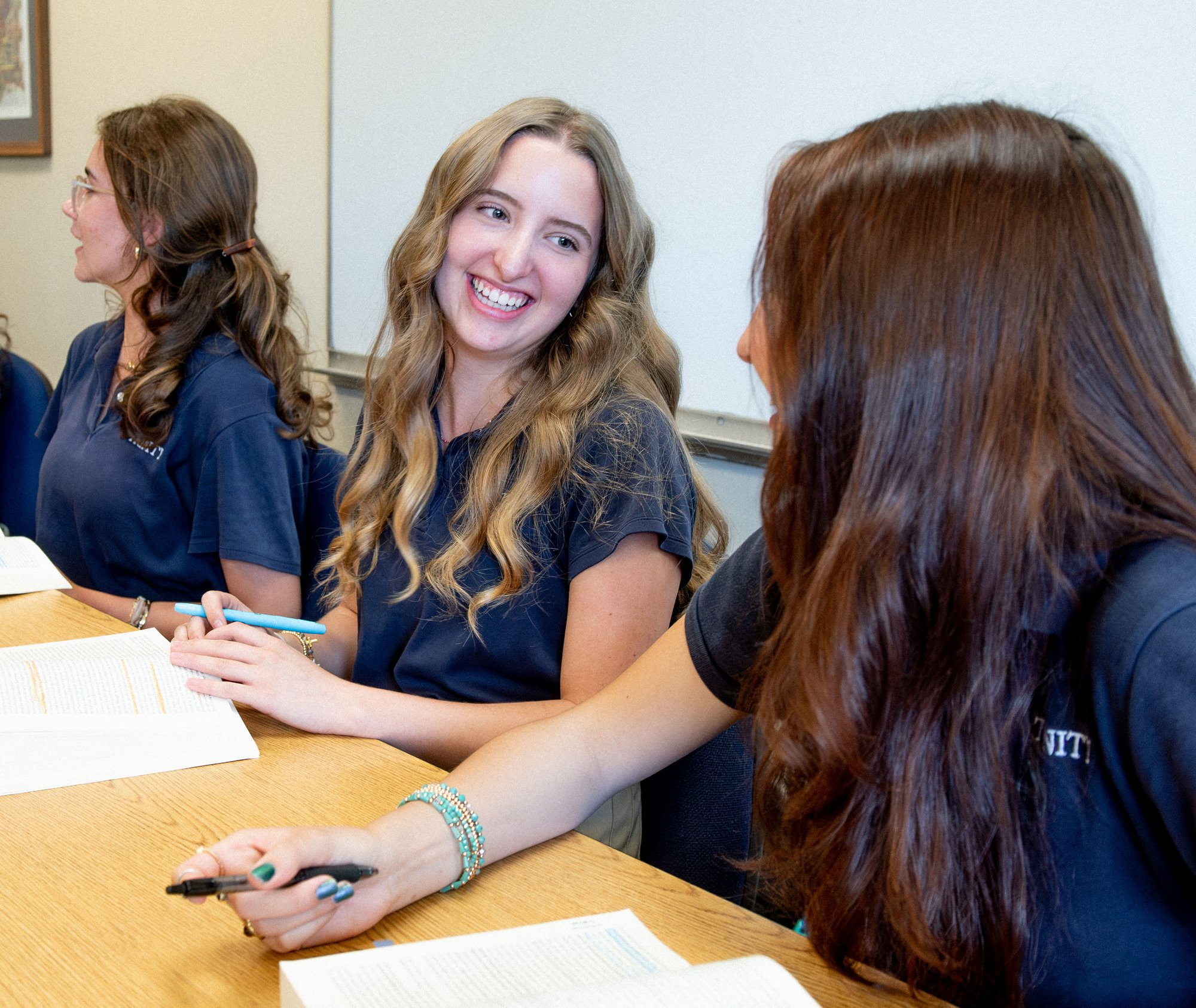
Trinity Academy is a coeducational school that offers separate-sex classes. We have found that, especially during the middle and high school years, boys and girls often learn best in classrooms tailored to their unique strengths and developmental needs. We understand men and women to be created by God, equal in dignity, but distinct from one another. Our classrooms uphold this equality and benefit from the complementary differences.
Approach to Technology & AI
We employ technology thoughtfully—when it enhances learning—within a curriculum that prioritizes human connection and engagement. While students study and use computer coding junior and senior year, most courses focus on traditional, hands-on learning. Students read and annotate the pages of books, conduct science experiments, paint and draw, sing in choirs, compose at the keyboard, and write responses by hand. By being intentional about technology, and by enforcing a no cell phone policy on campus, we affirm the values of thinking for oneself and contributing fully to one’s community.
College Guidance
Most Trinity Academy students aim to attend college upon graduation, with support from our guidance counselor. The outcomes speak for themselves.
.jpg?width=2000&name=Senior%20boys%20graduation%20(1).jpg)
Life After Trinity Academy
Because we view education as a lifelong process, we see graduation from Trinity Academy as a milestone rather than a bookend. It marks the completion of four or six years of intellectual, physical, social, and spiritual growth. At the same time, it signals the start of the transition from high school to college, career, or calling.
Whatever our graduates choose to do next, life after Trinity Academy is always a life of learning. The habits of mind ingrained here stay with Trinity students through adulthood. By staying connected with Trinity, alumni ensure that this community stays as intellectually engaged and spiritually vibrant as you remember.