
Why Latin?
On the day before Midwinter break, one of my students, weary of new and obscure grammar, finally issued a complaint saying, “Why are we studying this dead language?” I took the bait and asked him ...
On the day before Midwinter break, one of my students, weary of new and obscure grammar, finally issued a complaint saying, “Why are we studying this dead language?” I took the bait and asked him when a language is dead. He said, “What do you mean?” and I said, “If it is a dead language, when did it die? When does a language die?” Many of them did not know what to think.
One boy suggested that 500,000 speakers makes a language alive. Latin would be dead, but this criterion would declare Luxembourg’s official language dead, and Yiddish, the official language of no country, would still be thriving. Another boy suggested that a language is dead when it has no monolingual native speakers—a clever insight. Irish Gaelic by these standards would be almost dead; Icelandic, since 80 percent of Iceland speaks both English and Icelandic, would be in a precarious position. Welsh, thriving with over 500,000 bilingual native speakers, would be dead. “So when,” I asked, “does a language really die?” A third said when there are no speakers period. If so, Sumerian is probably dead, Hittite, Etruscan, Punic, but not Latin. One estimate places the number of Latin speakers at a little over five thousand. If a language needs any amount of native speakers to be alive, I know of several, and I have spoken with two of them myself. We returned to where we started—how many speakers makes it a living language?—and alas we could not pronounce why or when Latin died or if it has died at all. Finally, a student suggested that Latin maybe died at the peak of the British Empire, yet when the British General Charles Napier conquered Sindh in 1843, it is said that he sent a one-word telegram to the Governor General, peccavi, i.e. “I have sinned.”
Five thousand speakers and, to my knowledge, fewer than a dozen native speakers may prove in one sense that Latin is not dead. At the same time, however, there are about one thousand native speakers and between 30,000 and 2 million speakers of Esperanto, a language invented and published by L. L. Zamenhof in 1887. Why Latin? Why not Esperanto? Or more seriously, why not Mandarin, Hindi, Arabic, or French, the most spoken languages excluding English and Spanish? Often more pragmatic approaches amount to saying that it is good to know the logical structures of language itself, and remarks about vocabulary and SAT scores simply mean that it is good to know about the influence and origin of approximately half the vocabulary in the prepositional phrases of this current sentence. But there is a better reason to study Latin.
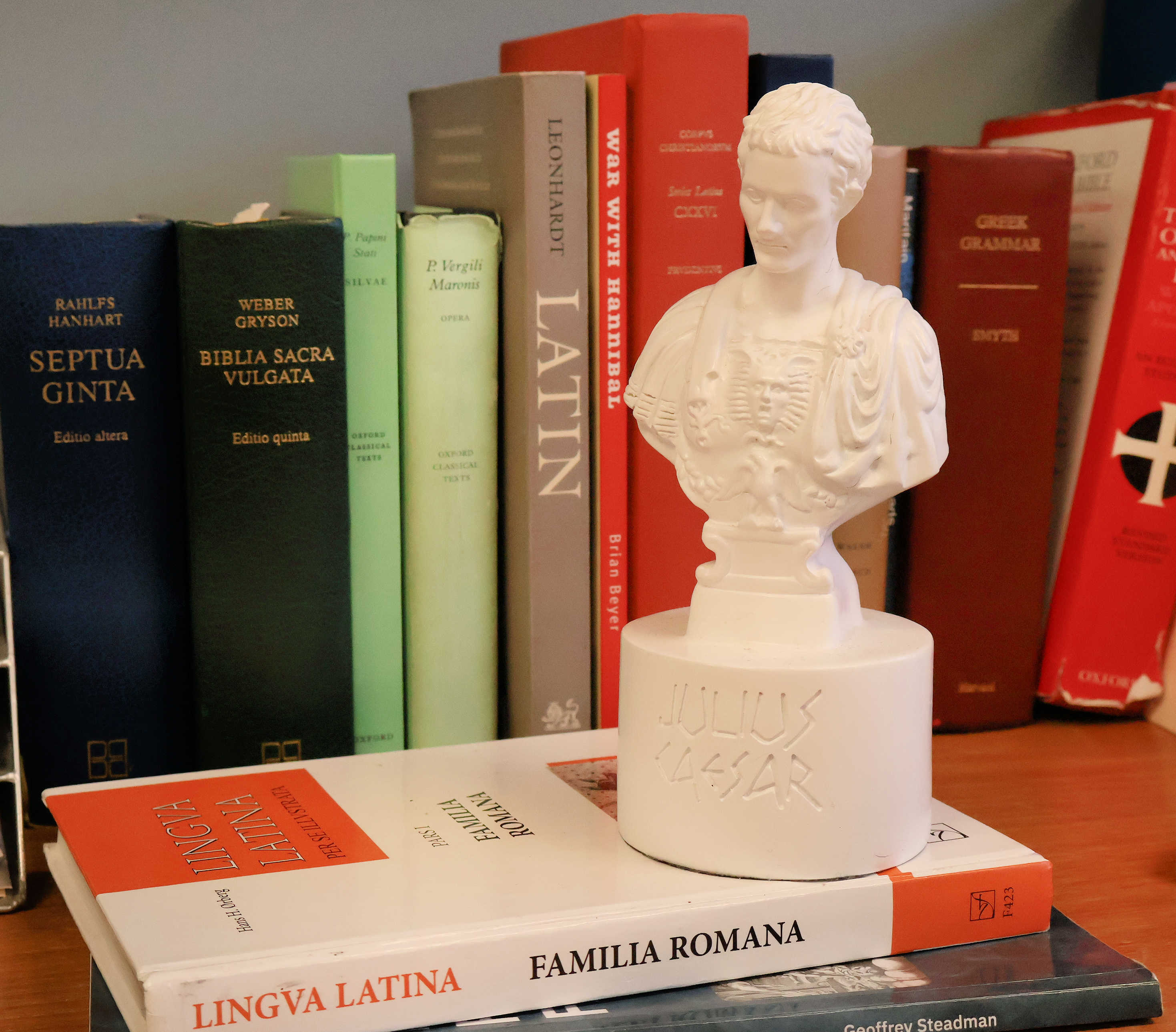
Latin was the language of the twelve tables, published in 449 BC; Latin was the administrative language of Charlemagne’s Empire in the 9th century AD; The documents of the 1648 Peace of Wesphalia are in Latin. Latin has been used continuously since the 7th century BC to the present day. From the reign of Charlemagne to the French Revolution, Latin was the language of administration and international communication. Latin was the language of math and science: Kepler, Newton, Gauss, Euler, and Descartes all wrote major works in Latin. The correspondence of Erasmus equals almost half of all the letters we have from antiquity. Few people would include C. S. Lewis among Latin authors, though he corresponded with a man, Don Giovanni Calabria, for seven years solely in Latin.
In January 2020, I attended a lecture on the Libellus de Medicinalibus Indorum Herbis. The Libellus is a medicinal text written in the style of the Roman naturalist Pliny the Elder; the book details some 250 plants used by the Aztecs and lays out their medicinal properties. The author of the text, Juan Badiano, was born in Xochimilco, Mexico, and at the school of Tlatelolco, Badiano made use of original botanical texts in his native language, Nahautl, in order to compose the Libellus. When I tell people that I teach Latin, books like the Libellus never come up in conversation, maybe because Tlatelolco is 6,363 miles from Rome.
Two cultural foundations of Europe and western civilization are Latin and Latin Christianity. Even before Jerome translated the Bible into Latin in the 4th century, Christians in the western empire and in North Africa were reading the Bible in Latin. During the Reformation, there were several new translations and editions of the Bible into Latin, both Protestant and Catholic. Preachers delivered sermons in Latin, especially at the university, not only in antiquity but through the early modern period. Be it religious, secular, administrative, artistic in purpose, Latin was the primary means of communication across borders and sometimes within. The amount of Latin written after the classical period makes up about 99.998 percent of the extant Latin texts; the ancient, Roman, pagan classics are 0.002 percent of extant Latin, or one out of every 50,000 books1. While these figures illustrate quantity over quality—Hamlet and the user manual of my car are perhaps the same word count—they also show two things: the breadth of the Latin heritage, and the influence of a canon.
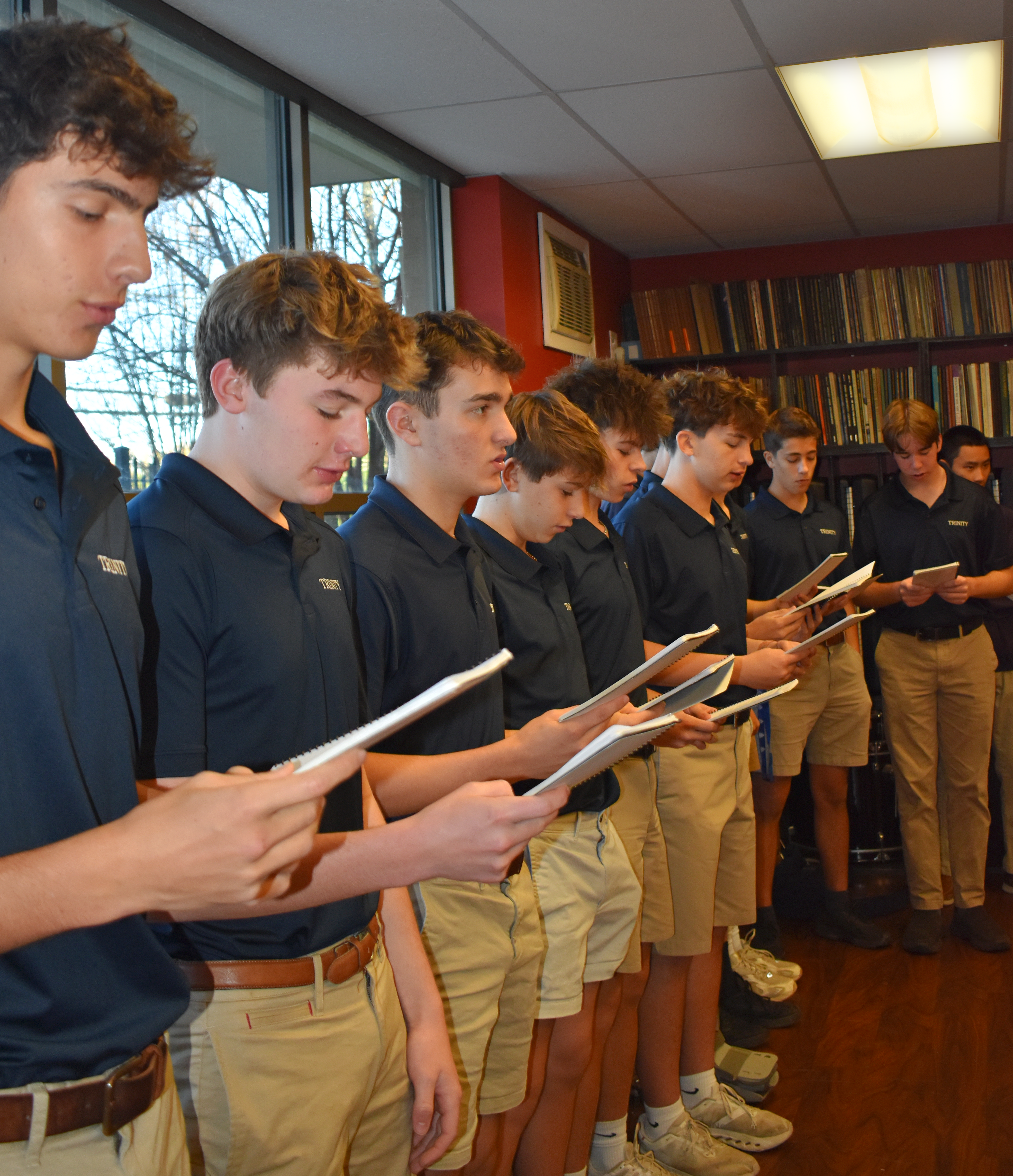
Throughout their Latin courses, Trinity students experience this heritage and receive this canon. They read not only Cicero, Caesar, and Virgil; but Scripture, Augustine, and some of the earliest Latin hymns. Though these authors have long passed, their heritage is not dead. Our students are living users of this ancient language. They do not simply translate; they craft the language as their own, and—I have to admit—they do coin new words and translate their own idiom into Latin. Our students debate the rhetoric of Cicero: they wrestle with his persuasiveness and the facts as he presents them. They enter the international politics of Caesar’s Gallic Wars and they discuss what makes a poetry epic, and furthermore, what makes it poetry.
If our alumni become statesmen, engineers, carpenters, or plumbers, why should they study Latin? I wonder if a man in one of these four careers would look back on his Latin differently from his biology or calculus. It could be that we study Latin for the same reason that we study history: it is crucial to know our origins, to know what came before, and the cultures we have inherited. But at the same time, how much more can one enter into a culture, his own or another’s, when he knows the language? With traditional subjects, perhaps the answer is similar to other aspects of tradition: tradition is the solution to problems we did not know we had.
1Jürgen Leonhardt, Latin: Story of a World Language, trans. Kenneth Kronenberg (Cambridge, MA: Harvard University Press, 2013), 2.
.jpg)